
Czech Student Visa & Residence Permit Requirements: Complete Checklist
Welcome to Part 3 of my series on navigating the Czech student visa and residence permit process. If you’re new here — hi, I’m Anne. I’m a former Master’s student who spent a year studying in Prague and lived through the Czech visa system firsthand. I came out the other side with a lot of knowledge I wish I’d had going in, and I built this series to simplify the process for anyone else starting it.
In this post, we’re breaking down the required documents for both the Czech student visa and the Czech residence permit — what each one actually is, where you get it, how long it takes, and what to watch out for. Think of this post as your complete checklist before you begin the application process.
Short on Time?
Quick Answer: Below are the official document lists for the Czech Student Visa and the Czech Residence Permit. You’ll notice they’re essentially identical — nine documents in total.
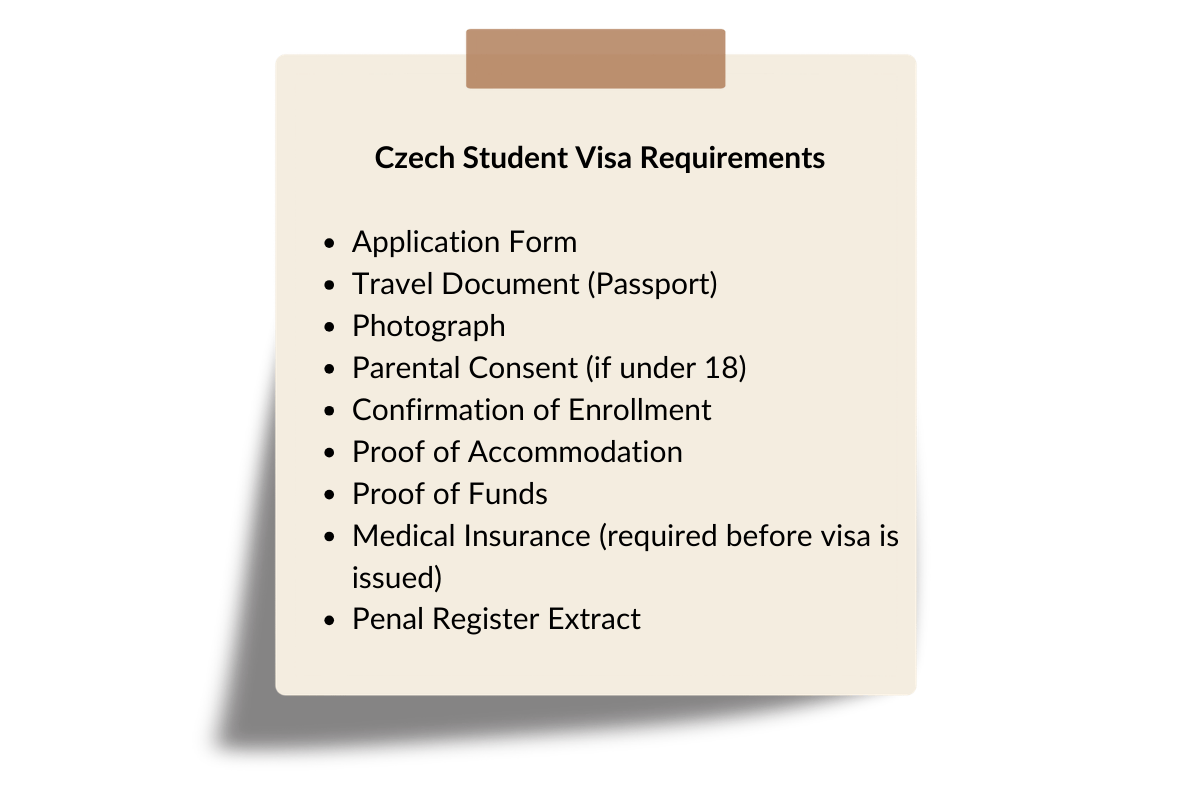
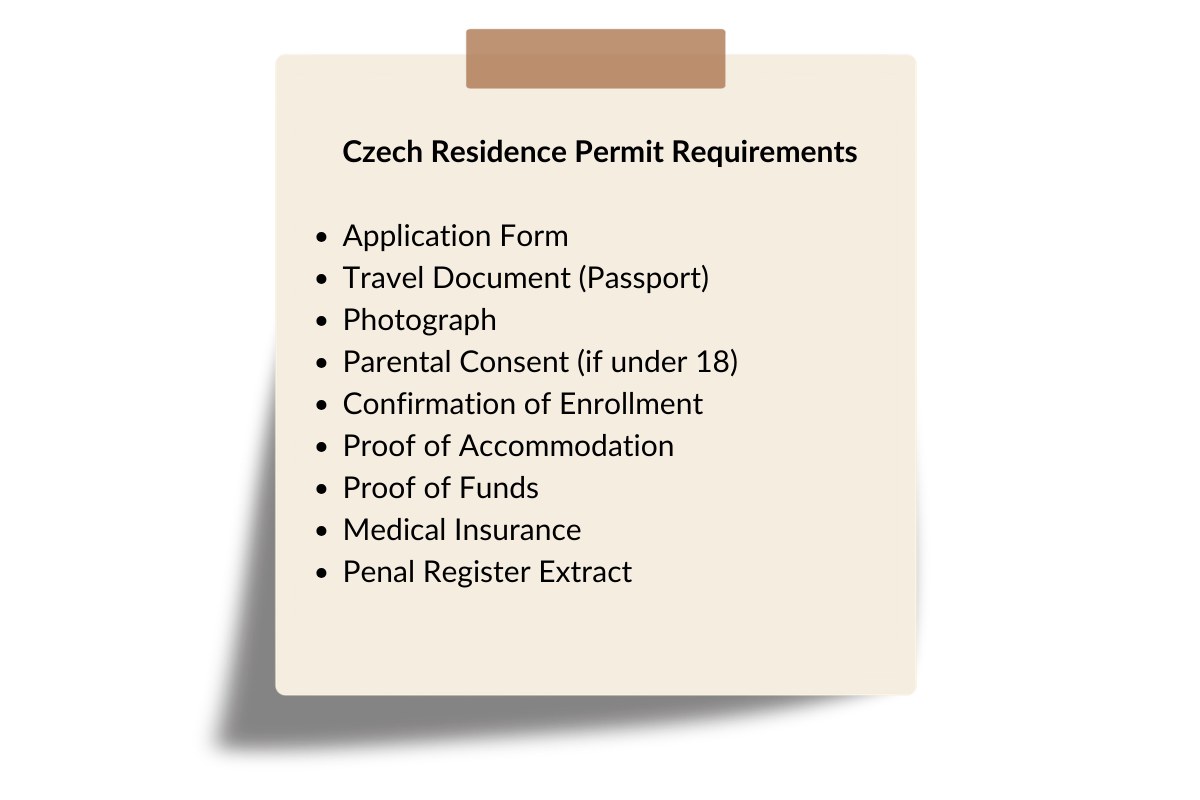
Don’t let these lists intimidate you. We’re going to walk through each document one by one below, grouping them into simple phases — starting with the core identity documents, then moving into your student documents, financial requirements, and finally the administrative pieces. By the end of this post, you will have a clearer picture of exactly what’s needed to apply.
If you’re looking for information on a specific requirement, feel free to use the table of contents to jump directly to that section.
Quick Recap
Before we dig into the document requirements, let’s do a quick recap of what we’ve covered so far. Post 1 broke down the difference between the Czech student visa and the residence permit — including how to determine which you need to apply for. Post 2 covered processing times for your application and how to avoid any processing delays.
As always, use the series guide above to navigate between posts if you need to. Now let’s go through the documents you’ll need for your visa or residence permit application.
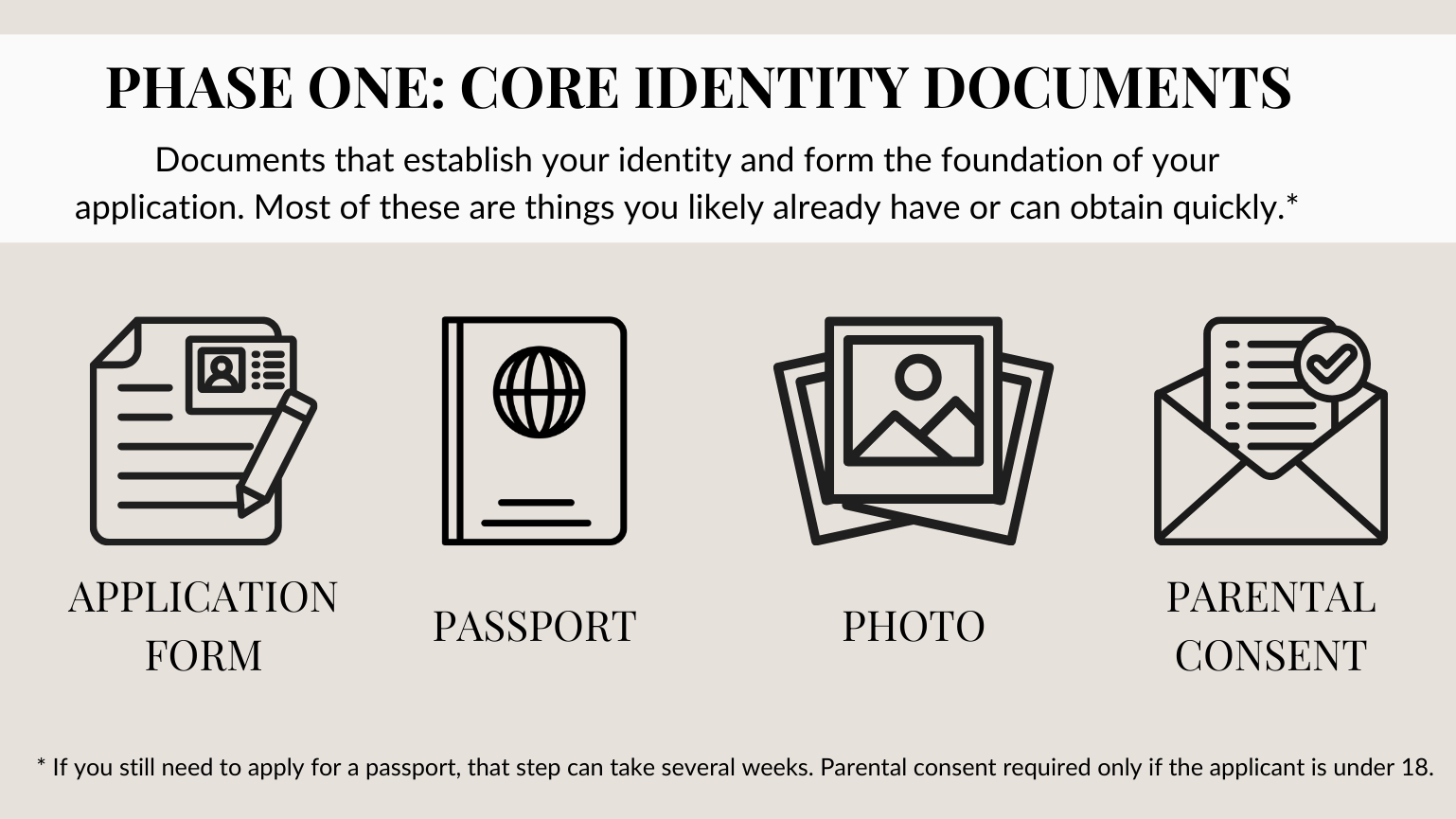
Application Form
What it is: This is the form that officially starts your Czech student visa or residence permit application. There are two separate forms depending on what you’re applying for — one for the long-stay visa and one for the residence permit — so make sure you’re downloading the right one.
Where to get it: Directly from the Czech Ministry of Interior website. I’ve also linked below in the resources section.
How long it takes: The form itself doesn’t take long to fill out, but give yourself a few days to work through it carefully — especially so you have time to ask your university or program coordinator if any questions come up.
My Tip: Download it and fill it out digitally using Adobe Acrobat or similar software. Those little squares are not made for handwriting — typing is so much easier, and it makes fixing typos a non-issue.
Resources: Long-stay visa application form | Residence permit application form
Travel Document
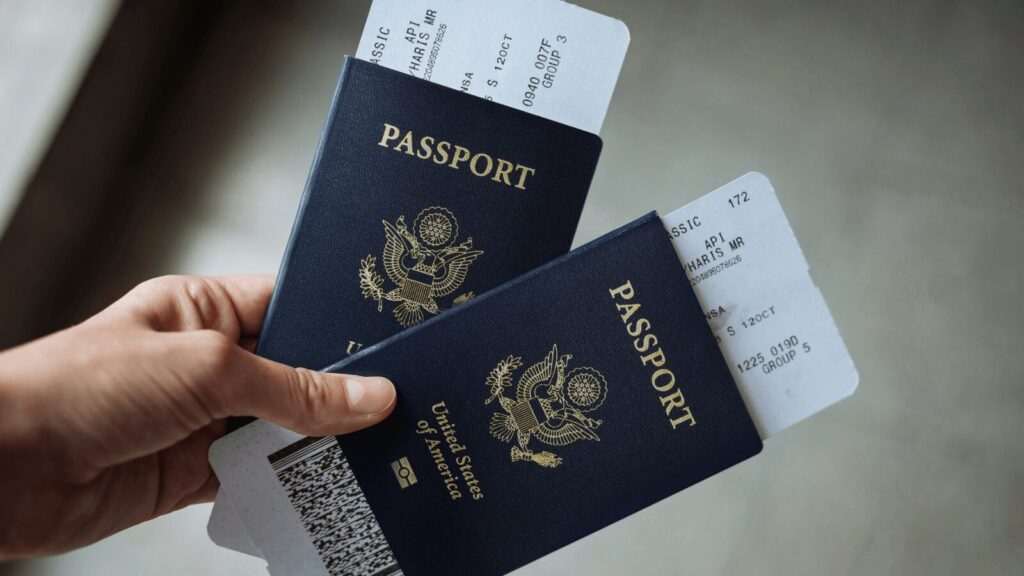
What it is: In almost every case, the required travel document for your application is your passport. This is the document verifies your identity and is where your visa will ultimately be issued.
Where to get it: If you’re an American applying for your first passport, you can apply through travel.state.gov. If you’re a citizen of another country, check your government’s official passport authority for the process.
How long it takes: The U.S. passport website currently lists standard processing at 4–6 weeks, or 2–3 weeks if you pay for expedited service. Build this timeline into your planning — this is one of the most avoidable delays. If you already have this document, then this takes no time at all.
Watch out for: Make sure your passport meets the validity requirements. For both the long-stay visa and the residence permit, your passport must be less than 10 years old, contain at least two blank pages, and remain valid for at least three months beyond the end date of your visa or permit.
One more thing: make sure your passport isn’t damaged. I know someone who accidentally put his passport through the washing machine before a study abroad trip and was denied a visa. A washed passport is a void passport — keep it somewhere safe, and if an accident does happen be sure to replace it in time.
Resources: Czech Ministry Travel Document Requirements
Photograph
What it is: A biometric passport-style photo that meets specific Czech government requirements. This is not just any headshot — there are strict rules around size, expression, background, and image quality. Basically the same rules apply that you have for a passport photo.
Where to get it: CVS or Walgreens are your best bets if you’re getting it done in the US — they can help ensure the biometric requirements are met. Just let them know it’s for a European visa application and give them the exact dimensions. If you’re already abroad, any local photo shop can do it quickly and will know the specs.
How long it takes: This one is easy — you can do it in a single day. Just don’t forget about it until the night before your appointment.
Watch out for: The size difference between US and Czech photo requirements. 45mm x 35mm, not the standard American 2×2. Get this right before you show up.
Resources: Czech Ministry Visa/Residence Permit Photo Requirements
Parental Consent
If you’re under 18, you’ll need a signed parental consent form as part of your application. This one is pretty self-explanatory — if it applies to you, make sure it’s signed before your appointment.
Resources: Czech Ministry Parental Consent Form
Confirmation of Enrollment
What it is: An official document issued by your university confirming that you are enrolled as a student. It needs to include specific details — the school’s name and address, an authorized signature, the school’s stamp, and information about you including your name, citizenship, date of birth, expected length of stay, and your study program type.
Where to get it: Your university. This one is largely out of your hands, which is actually kind of a nice thing — the school handles it. In my experience it was one of the easiest documents in the whole process. My university sent it to me well in advance without much back and forth.
How long it takes: This depends on your university’s timeline, but generally it comes through once your enrollment is confirmed. Don’t assume it’s on its way though — if some time has passed and you haven’t received it, follow up with your program coordinator.
Watch out for: This is a non-negotiable document for your application. Make sure it includes all the required details listed above. If anything is missing or incorrect, ask your university to reissue it before your appointment. It’s also worth noting that delays on this document can have a domino effect — some insurance providers and accommodation options may require your confirmation of enrollment before you can finalize anything with them.
Resources: Czech Ministry Confirmation of Enrollment Further Information
Proof of Accomodation
What it is: Documentation proving you have a place to live in the Czech Republic. This can take a few different forms — most commonly a lease or sublease agreement, or a confirmation of accommodation from your university or housing provider. As long as it shows you have a confirmed address for the duration of your stay, you’re covered.
Where to get it: This depends entirely on which housing route you take, and there are two main options.
Housing Options

Option One
The first option is university housing — aka the dorms. Not always the most glamorous option, but often the easiest. Your university usually handles the paperwork and provides a confirmation of accommodation, which takes care of this requirement. When I studied abroad in Germany, my university handled dorm placement completely. Yes, mine was located in the middle of a BMW and Mercedes dealership parking lot on the outskirts of town (very German), but it was CHEAP, costing around $216 a month, and took all the stress out of finding somewhere to live.
Option Two
The second option is private accommodation — finding your own apartment or room through a rental platform, broker, or private landlord. This is doable, but it comes with real challenges. The housing market is competitive, especially if you’re studying in Prague. If you’re not familiar with the city or don’t speak Czech, navigating it from abroad adds another layer of difficulty. When I lived in Prague I went the private route and used a broker. Honestly? I regret it. I paid one month’s rent as commission — money I could have used for literally anything else. It did give me peace of mind and convenience, so if that’s worth it to you, it’s a viable option. But go in knowing the cost and risks.
My tip: if you’re going for a semester, opt for the dorms — cheaper, easier, and one less thing to stress about. If you’re there for a year or longer, use your judgment. You could always do your first year in the dorms, get to know the city, and potentially meet future roommates before committing to a private lease.
How long it takes: University housing can move quickly once you apply — just don’t leave it until the last minute in case spots fill up. Private accommodation is a different story. My search took three months, and that’s with help from a broker. Build that into your timeline.
Watch out for: Scams. Rental platforms can unfortunately be full of them, and they target people searching from abroad. If a listing looks too good to be true — unusually cheap, suspiciously nice photos, a landlord who won’t give a virtual tour — trust your instinct.
Stick to reputable platforms, and if possible get a local contact or a current student to help vet listings before you send any money or personal documents. Always go with your gut feeling, if something feels off it probably is.
Resources: Czech Ministry Proof of Accomodation Specifics
Proof of Funds
What it is: Documentation proving you have enough money to support yourself during your stay in the Czech Republic. The Czech government wants to know you won’t run out of money while you’re there — this is how you prove it.
Where to get it: For most students, this will be a bank statement showing that you have the required funds available in your account. You may also be asked to show the debit card linked to that account to confirm you can access those funds while in the Czech Republic. If your studies and living costs are covered by your university or a sponsoring organization, you can instead submit a scholarship confirmation letter. Check the resources section linked below for full details on all acceptable forms of financial proof.

How much do you actually need? The required amount is based on something called the “subsistence minimum” — basically just a fancy term for the minimum amount of money the government considers necessary to live on. In the Czech Republic that’s currently set at 3,130 CZK per month (roughly $150 USD).
Here’s how the math works: for your first month you need 15x the subsistence minimum, then for every additional full month of your stay you add 2x the subsistence minimum on top of that. So for example, if you’re staying for six months, you’d need 15x for the first month plus 2x for each of the remaining five months — that comes out to 78,250 CZK, or roughly $3,733 USD.
The longer your stay, the more you’ll need to show. If that formula made your eyes glaze over — same. That’s exactly why I built a calculator to do the math for you.
Use the Funds Calculator
My Tip: Rather than doing the math yourself, use my Czech Student Visa Funds Calculator to figure out exactly how much you need to show in your account based on your specific start and end dates — with a live conversion into USD.
How long it takes: A bank statement can be pulled relatively quickly once the funds are in your account. That said, don’t let the ease of getting the statement itself lull you into a false sense of security — if you’re using an American bank statement, factor in time to have it translated into Czech. That step can take a few days to a couple of weeks depending on the translator, so don’t leave it until the last minute.
Watch out for: American bank statements are totally fine to use — but they must be translated into Czech. This one caught me off guard at my appointment and cost me over $100 in expedited translation fees. Pull your statement early and get it translated ahead of time so you’re not scrambling. One more thing — the CZK to USD exchange rate fluctuates constantly, so if you’re calculating how much you need in your account, don’t cut it too close. Build in a little buffer if you can so an exchange rate shift doesn’t leave you short.
Resources: Czech Ministry Funds Requirements – Visa | Czech Ministry Funds Requirement – Residence Permit
Medical Insurance
What it is: Proof that you have medical insurance covering your stay in the Czech Republic. Both the long-stay visa and the residence permit require this, but the timing and specifics differ between the two.
For the long-stay visa, insurance isn’t required at the time you submit your application — but you must provide proof before the visa is physically added to your passport.
For the residence permit, the requirements are more detailed. When you submit the application, you need either travel insurance covering necessary and urgent care for the first 90 days plus comprehensive insurance for the remainder of your stay, or comprehensive insurance covering the entire period upfront. Your certificate must confirm that coverage is valid for the full duration of your stay.
The minimum coverage threshold for the residence permit is EUR 400,000 per insured event, with no cost-sharing by you as the insured person.

Where to get it: Shop around, but I used Onlinecizinci.cz and went with their health insurance for foreigners plan. It came out to 12,800 CZK for the year — roughly $610 annually, or about $51 a month. For context, my health insurance in Austria my first year was about four times that amount so Czech insurance is pretty affordable.
How long it takes: Once you’ve chosen a provider, you can typically get your certificate within a few days.
Watch out for: Two things. First, make sure your plan actually hits the EUR 400,000 minimum coverage threshold — not all international student plans do. Second, if you purchase insurance abroad (for example from a US provider), you’ll need a certified Czech translation of your insurance agreement, so factor that in if you’re sorting this before you arrive.
Resources: Czech Ministry Medical Insurance Requirements
Penal Register Extract
What it is: A background check — essentially proof that you have no criminal record.
Where to get it: Through the FBI, but don’t let that intimidate you. There are plenty of third-party providers that make the process straightforward. I used Fieldprint — you book an appointment at one of their locations (often at a post office), get your fingerprints taken electronically, and your results are emailed to you fairly quickly. If you’ve lived in another country for more than six months in the last three years, you may also be asked to provide a background check from that country too.
How long it takes: This one takes the longest of anything on the list as you have to get it translated and Apostilled — give yourself plenty of runway and don’t leave it until the last minute. If you’re wondering what an apostille actually is, don’t worry — I explain that in the next post.
Watch out for: Two things. First, the document will need an apostille and a certified Czech translation. Factor both into your timeline. Second, Czech authorities generally prefer records that are no more than three months old, so don’t request it too early either.
One honest note: the official Ministry checklist lists this as a standard requirement, but in practice it seems to be applied at the embassy’s discretion — when I applied for my residence permit in Prague, they didn’t ask for it at all. Before you go through the full process, reach out to your embassy or program coordinator to confirm whether you actually need it. It’s not a cheap document to obtain between the FBI fees, apostille, and certified translation, so it’s worth a quick email before you spend the money.
Resources: Czech Ministry Background Check Requirements

Final Thoughts
Whew — I know that was a lot of information to throw at you at once, but hopefully this post helps clear up any questions on the actual document requirements themselves. If you have any further questions, drop them in the comments below or send me a message and I’ll do my best to point you in the right direction.
In the next post we’re covering everything you need to know before you actually submit your application — common mistakes that cost people time and money, apostilles, the 180-day document window, FAQs, and a full final prep checklist. See you there!