
Before you Apply – Common Mistakes, FAQ & Final Prep
Welcome back to Part 4 of my Czech student visa and residence permit series — in this part we’re focusing on the parts of application prep that are easy to overlook before your consulate appointment. Knowing which documents to provide is only one piece of the puzzle — there are other important considerations like apostilles and certified translations that need to be sorted before you hand anything in. And if you have zero clue what an apostille or certified translation is, don’t worry, I explain it all without the bureaucratic gibberish so you show up to your appointment 100% prepared for an easy breezy approval.
Before we get into it — if you’ve just stumbled across this series, hi! I’m Anne, a former Prague resident who went through the student residence permit process firsthand and built out this visa and residence permit series so you don’t have to figure it all out alone (or feel like you’re being slowly consumed by Czech bureaucracy, which is a very real feeling).
This is Post 4 in the series. If you’re jumping in here and still have questions about which visa type applies to you, how long the process takes, or what documents you actually need, I’d really encourage you to start from the beginning — links to the full series are below.
For everyone who’s caught up: in this post we’re covering the terminology you’ll keep seeing thrown around (apostilles, certified translations — demystified, I promise), the most common mistakes to avoid, and a FAQ section for everything else.
Short on time?
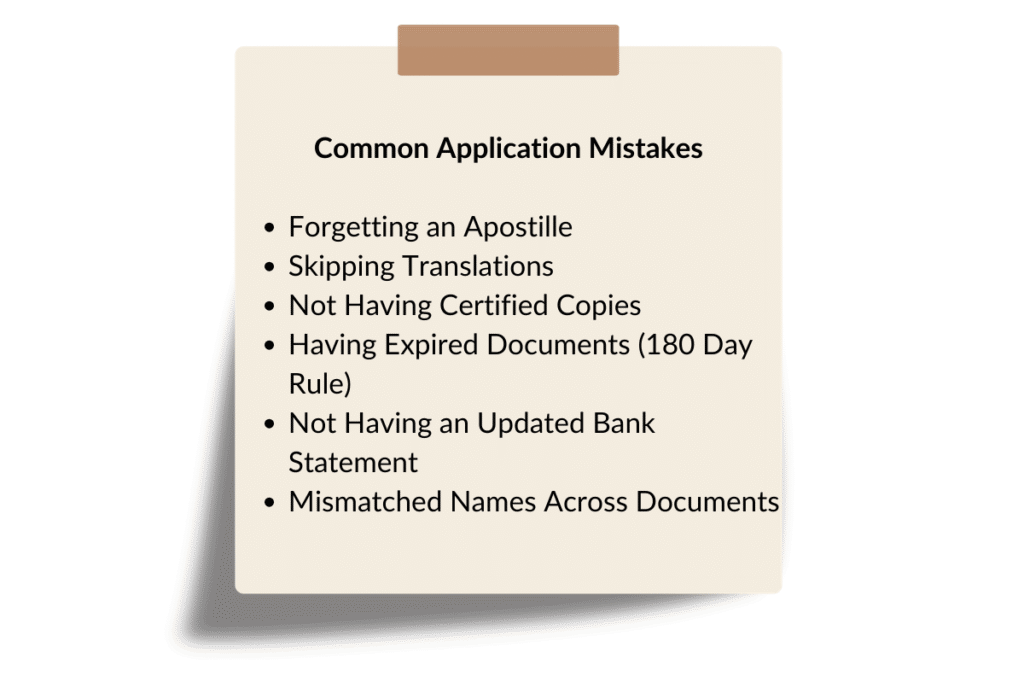
TL;DR Here’s the quick version — these are the six most common mistakes people make when preparing their Czech visa or residence permit documents. I explain everything in detail in the post.
Quick Recap
Before we get into the mistakes and FAQs, here’s a quick recap of where we’ve been. Post 1 breaks down the difference between the Czech student visa and the residence permit — including how to figure out which one applies to you, Post 2 covers the application timeline, when to start, and what to expect in terms of processing times, and Post 3 goes over the full documents checklist — every document you’ll need and where to get it. If you haven’t read those yet, be sure to check them out if you have any questions.
As always, use the series guide above to navigate between posts whenever you need to.
Demystifying Common Visa Terminology
First I want to quicky break down two terms that come up constantly in the visa and residence permit application process — because these consistently cause confusion.
What is an Apostille?
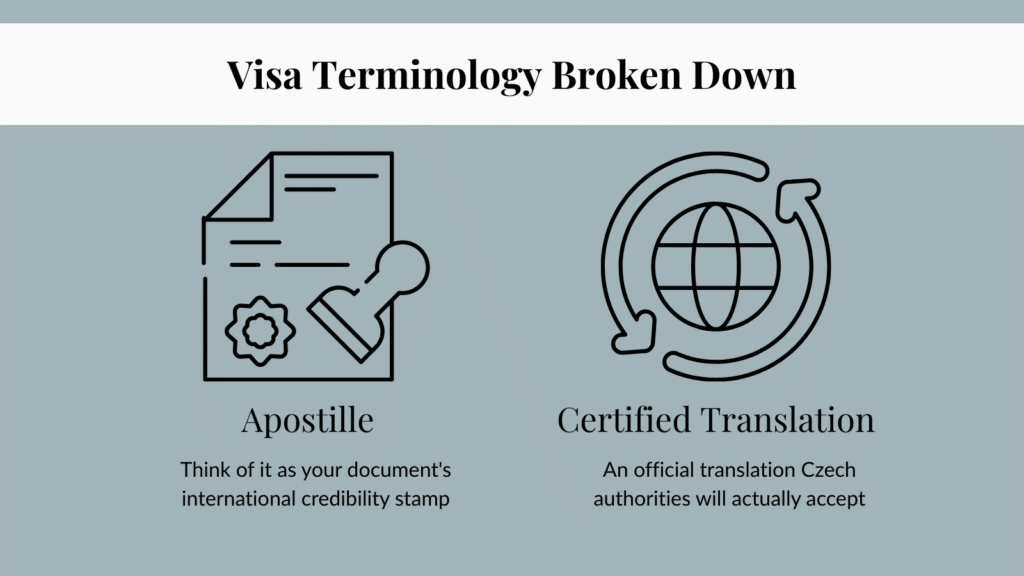
This can sound very intimidating, but an apostille is essentially just an official stamp of authenticity that tells a foreign government: yes, this document is real, and yes, it was legitimately issued in this country.
The concept comes from the Hague Convention — an international agreement signed by over 120 countries that created a standardized system for verifying official documents across borders. If your home country and the receiving country are both part of the Hague Convention (the Czech Republic is, and so is the US), an apostille is all you need to have a document recognized abroad.
For US citizens specifically, how you get an apostille depends on the document. State-issued documents — like a birth certificate — are apostilled through your state’s Secretary of State office. Federal documents, like the FBI background check, go through the US Department of State. If you’re not a US citizen, be sure to double check how the process works in your country by starting here.
Resources:
- General Apostille Info for the Czech Visa/Permit Process
- Competent Apostille Authorities in the US
- More on US Apostille Process
What is a Certified Translation?
A certified translation is a translation completed by a sworn or accredited translator — not Google Translate, not a bilingual friend, not your cousin who took four years of Czech in college. Czech authorities require translations that come with the translator’s official certification that the content is accurate. I’ll link the translator I personally used as well as the Czech Ministry of Justice registry of sworn translators so you have somewhere to start
Resources:
- General Certified Translation Info for the Czech Visa/Permit Process
- List of Czech Translators
- Translation Service that I Used
Common Application Prep Mistakes
Now I’m going to cover some of the most common mistakes that can happen in the visa or residence permit application process. I’ve personally made a lot of these mistakes, so hopefully this saves you from finding out the hard way.
The Apostille Trap
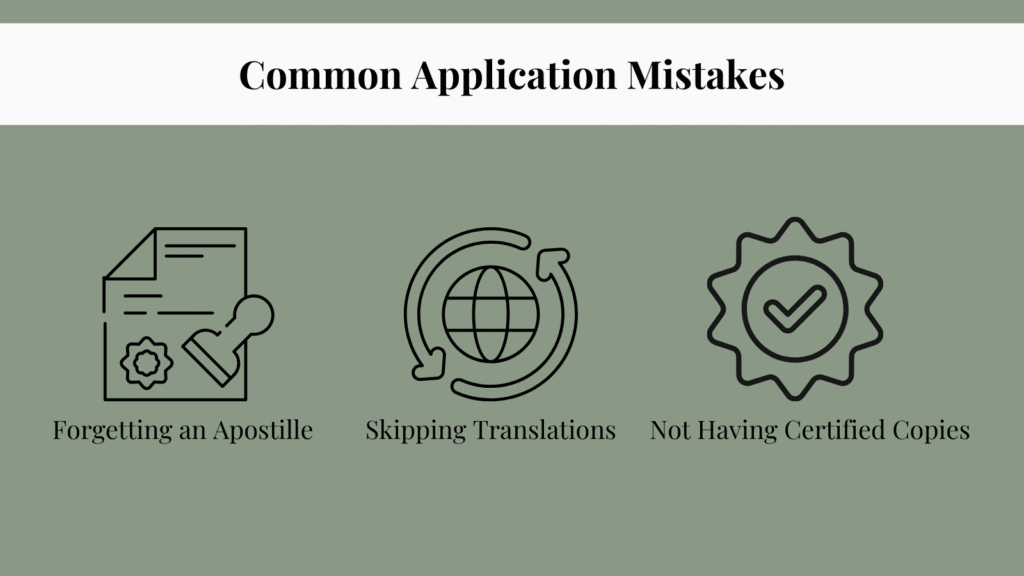
Here’s the thing about apostilles — whether you actually need one depends entirely on the document and the country you’re applying in. And nobody tells you this upfront — making it harder to tell what needs an Apostille and what doesn’t.
Learn from my experience. I did not need an apostille for a single document during my Prague residence permit application. (To be clear — I also did not need a background check for my residence permit in Prague.) But when I applied for my Austrian residence permit, I showed up to my embassy appointment with my FBI background check in hand, feeling completely prepared — and was told on that it needed to be apostilled. I had to leave, sort it out, and pay upwards of $150 for an expedited apostille to get it done in time. Standard apostille processing can take up to three months. If I had known that going in, I would have started the process months earlier and saved myself a lot of stress and money.
The most likely document to require an apostille is your criminal background check — so that’s the one to investigate first. For your Czech application specifically, confirm with your consulate or program coordinator whether a FBI check is required. If it is needed, make it one of the documents you prioritize getting done first, as this does require an apostille.
Don’t Skip the Translations
Translate everything that isn’t in Czech or Slovak. Every single document. I cannot stress this enough — and I say that as someone who made this mistake. The only document you won’t need to translate is your passport.
Coming from the residence permit process in Germany and Austria, I’d always submitted documents in English or German without any issues. So when I showed up to my Prague residence permit appointment with my American bank statement, I didn’t think twice about it. Sike — they did not accept it and required it to be translated to Czech before processing my application. I had to scramble to find a certified translator, pay expedited fees to get it done and mailed back in time, and ended up spending upwards of $100 — all for a document that is essentially just numbers on a page. Still baffles me, but here we are.
Don’t make the same mistake. It doesn’t matter how straightforward the document looks, how many numbers are on it versus actual words, or how internationally recognizable the format is. If it isn’t in Czech or Slovak, it needs a certified translation attached.
And when I say certified translation, I mean a sworn or accredited translator — not Google Translate, not a bilingual friend. Czech authorities require translations that come with the translator’s official stamp and certification. See the above section for resources on where to find translators.
Originals vs. Copies — And What “Certified Copy” Actually Means
Documents must be originals or certified copies. Printed screenshots, email confirmations, and photocopies will oftentimes not be accepted. (Screenshots trigger me to my mortgage processing days — please don’t show up with printed screenshots.)
An original is exactly what it sounds like: the actual document issued to you. A certified copy is a photocopy that has been officially verified as a true and accurate reproduction of the original — typically stamped and signed by a notary or other authorized official. (You can check the resources below to see who can provide a cerified copy in the Czech Republic.) It is not the same as walking up to a photocopier and making a copy yourself, even if that copy looks identical.
In practice, for most of your documents you’ll be submitting the original. The certified copy route tends to come up when you either can’t physically hand over an original (some institutions won’t reissue documents, and you may need to keep the original for other purposes) or when the consulate specifically requests it. Another note: certified copies cannot be made for documents like your passport.
One habit worth building regardless: bring a regular copy of every single document to your appointment anyway. Not as a substitute for the original — just as backup. Some consulates will keep your originals on file, some will return them, and having a copy set means you’re never left without a record of what you submitted.
Resources:
A Few More Things to Watch Out For

The 180-day Window for Documents
Most of your documents cannot be older than 180 days at the time of your application. Your passport is an exception, but things like your bank statement, confirmation of enrollment, and background check all fall under this rule. The mistake people make here isn’t not knowing about the rule — it’s requesting documents too early and having them expire before their appointment comes around. Be strategic about timing.
Make Sure Your Funds are Actually Visible
Your proof of funds needs to show sufficient funds in your account at the time the statement was issued — not the day before, not after a top-up you made the morning of your appointment. If your balance dips below the required threshold at the wrong moment, the statement becomes a problem. Check the current minimum requirements and make sure your account reflects that consistently before you print the statement. Also, be sure to bring the debit card that you use for the account. At my appointment they made a copy of the card as proof that I can access the funds in the Czech republic.
Here’s something a tip from my mortgage days: bank statements typically only come in 30-day chunks tied to your statement cycle. So say your monthly statement cuts on the 15th, your funds cleared on the 20th, and your appointment is on the 1st of the following month — before your next statement is even out. In that case, you’ll usually need to pull your most recent official statement plus a transaction history to cover the gap. Just make sure that transaction history includes identifying information — your account’s last four digits, your name, something that ties it back to the official statement. Every bank handles this a little differently, so if you’re unsure, call them and ask. They deal with this more than you’d think.

And please, do not show up with a screenshot of your account balance and a “look, it’s in there” energy. The office will not be pleased.
Not sure how much you need to have in your account? I’ve built out a visa cost calculator that breaks it all down so you know exactly what you’re working with.
Mismatched Names Across Documents
This one is easy to overlook. If your name appears differently across documents — a middle name on one but not another, a hyphenated surname that’s inconsistent, a nickname that crept onto a form — it can raise flags. Make sure the name on every document matches your passport exactly. If there’s a legitimate discrepancy (a legal name change, for example), be prepared to explain it and bring supporting documentation.
Frequently Asked Questions
How far in advance should I start gathering documents?
Earlier than you think. Some documents have longer lead times than others — the FBI background check in particular can take several weeks, and if it needs an apostille on top of that, you’re looking at potentially months. A good rule of thumb is to start the process at least three months before your intended appointment date, and build your timeline around your longest lead-time document first. Post 2 in this series covers the full application timeline in detail if you want a more specific breakdown.
What should I do if I need an apostille or certified translation ASAP?
Been there — multiple times. The good news is that expedited options exist for both. The bad news is that they come at a cost. For my express apostille on my background check and my express certified translation, I’ve linked the providers I personally used here and here. Not cheap, but when you’re on a deadline they’re worth every penny.
What about exchange rates and proof of funds?
This can get a little fuzzy. If you’re applying with an American bank statement — which is completely fine, I did the same — your funds are in USD, but the Czech minimum requirements are set in CZK. The exchange rate fluctuates, so a balance that clears the threshold one week might look different the next. My advice: use the visa funds calculator here to see the current converted amount, then pad it by around 5% to give yourself a comfortable buffer against any rate movement before your appointment.
Final Thoughts

If there’s one thing I want you to take away from this post, it’s that preparing your documents for a Czech visa or residence permit is like an onion — it has layers. Don’t just take the documents you need at face value. If you need a background check you will need an apostille. If any of your documents are not in Czech or Slovak, you will need a certified translation 9 times out of 10 (exceptions include your passport). The details matter, and they’re easy to miss.
The mistakes covered in this post are incredibly common, and almost all of them are completely avoidable with a little advance planning. Get ahead of your apostille situation early, translate everything that isn’t in Czech or Slovak before your appointment, and double check your dates against the 180-day rule before you walk out the door. Future you will be very grateful.
Next up is Post 5 — where we get into the actual submission process. Where to apply, how to book your consulate appointment, what to bring on the day, and what to expect when you get there. That’s where you start to feel like you can see the light at the end of the tunnel in regards to the visa or residence permit process. As always, if you have any questions about anything covered in this post, feel free to leave a comment or message me directly — I’ll do my best to help based on my own experience. See you in Post 5.