
After You Apply: Approval, Next Steps & Picking Up Your Visa or Permit
Welcome back to my Czech Student Visa and Residence Permit Guide. Today we’re finally hitting the home stretch — what actually happens after you submit your application.
This post walks you through how to track your application status, what to expect after approval, and the next steps depending on whether you applied for a long-stay visa or a long-term residence permit. I also cover what options you have if your application is rejected.
If you’re just finding this series, welcome! I’m Anne — I went through the student residence permit process in Prague during my Master’s degree and built this guide to help make the process less overwhelming for everyone else. This is the final post in the series, so if you have questions about earlier stages of the application, the full series guide is linked below.
By the end of this post, you’ll know exactly what to expect from submission to having your visa or permit in hand.
Short on Time?
Here’s a quick rundown of what this post covers:
- Track your application using your reference number on the MOI portal — you’ll most likely see “being processed” for a while before the approval status appears
- If you applied for a long-stay visa: once approved, schedule your collection appointment at the consulate where you applied, bring proof of medical insurance, and register with the Foreign Police within 3 working days of arriving in the Czech Republic
- If you applied for a long-term residence permit: once approved, register with the MOI within 3 working days of arriving in Czech Republic, attend your biometrics appointment, and then collect your residence permit card
- If your application is rejected, you have 15 days to appeal or request a new assessment depending on your application type — rejections are rare but it’s good to know your options
Quick Recap
Before we dive in, here’s a quick overview of everything the series has covered so far. Post 1 breaks down the difference between a Czech student visa and a residence permit — the starting point for figuring out which application path applies to you; Post 2 gets into the timeline, walking you through when to start the process and how long it realistically takes to get an approval. Post 3 is the full documents checklist — everything you’ll need to gather and where to actually get it; Post 4 covers the deeper layers of document prep: apostilles, certified translations, and the mistakes to avoid before you even set foot in an office. And Post 5 covers the appointment itself — where to apply, how to book, and what to expect on the day.
If you’re missing any context, the series guide above has you covered.
How to track your Czech Student Visa or Residence Permit Application

First things first — you’ve just submitted your application. Now what? Honestly, there’s not much to do but sit back and wait for a decision. If you’re anything like me, going without updates is painful. Luckily, the Czech Republic does give you a way to check your application status online — and whether you applied for a long-stay visa or a residence permit, it’s the same portal. I’ve linked it below.
To track your status, you’ll need your reference number — the consulate gives this to you on the day of your appointment, so make sure you keep track of it.
I’ll be upfront: I’m not the biggest fan of this portal. It gives vague updates, and I found it nearly impossible to get any information beyond what it shows there. In my case, I had to send in a translated bank statement by mail and just wanted confirmation it had been received — but getting that confirmation was not possible. I tried calling the client center, but they told me to just wait for updates in the portal. I’m not sure if this was specific to applying through the Ministry of Interior in Prague, because a friend who applied at the Dresden Visa Center was able to get clearer updates from an actual person there. (If you’re not sure what I mean by that — head back to Post 5 for more on application routes.)
The three status messages you’ll most commonly see:
Being processed — the Ministry of the Interior is still reviewing your application. There’s nothing to do here but wait.
Preliminarily assessed positively — the Ministry of Interior has reviewed your application and the outcome is looking good. Time to move on to the next step.
Rejected — your application has been rejected or the administrative procedure has been discontinued. If this happens, you’ll receive written notification with the decision. You have 15 days from the date the notification was delivered to appeal.
You’ll likely see “being processed” for weeks, and then one day the coveted “preliminarily assessed positively” finally appears. In the meantime, keep an eye on your post and any missed calls — if the Ministry needs additional documentation, this is typically how they’ll reach out. Mail is the most common method, but I also know people who received a phone call directly from the Ministry.
Once you see that approval message in the portal, the next steps depend on whether you applied for a long-stay visa or a long-term residence permit — the process looks a little different for each. I’ve broken them out into separate sections below, so jump straight to whichever applies to you.
Resources:
- Application Tracking Portal
- Client Center Contact Information
- Student Residence Permit Tracking Info: See 5 & 6
- Student Visa Tracking Info: See 5 & 6
If You Applied for a Long-Stay Visa
What Happens After Approval
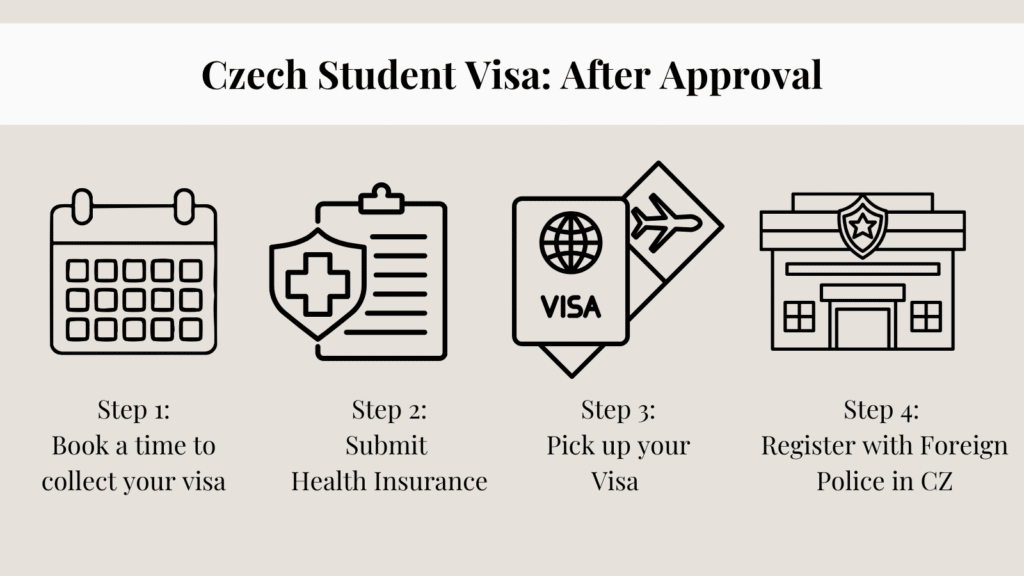
Once your visa is approved, the hard part is over — congratulations! There are just a few last steps to take care of before you can start living your best student life in Prague (or elsewhere in Czech Republic). These include:
- Scheduling an appointment to collect your visa at the diplomatic mission where you applied
- Providing proof of medical insurance
- Getting the visa stamped in your passport
- Registering with the Foreign Police after arriving in the Czech Republic
Getting Your Visa: Your Collection Appointment + Proof of Medical Insurance
An employee will contact you to schedule your collection appointment. Typically you’ll go back to the consulate/embassy where you applied for the visa to collect it. When you go in, you’ll need to bring proof of medical insurance before they’ll stamp the visa in your passport.
There are two ways to meet the insurance requirement:
Option A: Travel medical insurance covering emergency and essential care for your first 90 days in the country, plus comprehensive medical insurance for the rest of your permitted stay.
Option B: Comprehensive medical insurance covering your entire permitted residence in the country from day one.
Throughout my residence permit applications, I have found it’s usually easier and cheaper to go with Option B and have the comprehensive medical insurance covered from the time you enter Czech Republic. However, each situation is different, so do some research and go with what is best for you. The diplomatic mission may also ask for proof that you’ve actually paid for your policy as a head’s up. If you need a refresher on what comprehensive medical insurance actually means and what to look for in a policy, I cover it in detail in Post 3.
A Note on Insurance Going Forward
Travel insurance works fine to get your visa in hand, but it’s not a long-term solution. Comprehensive medical insurance is a requirement for the duration of your stay, so if you’re starting with a travel policy, make sure you have a plan for transitioning to comprehensive coverage before it expires.
Entering Czech Republic: Registering with the Foreign Police Within 3 Working Days
The next thing to take care of will actually happen once you’re on the ground in the Czech Republic. Within 3 working days of arriving, you must register your address with the Foreign Police.
I went through this process myself — even though I applied for a residence permit rather than a long-stay visa — so I can give you some insight on what to expect. And I’ll be honest: it’s an intimidating experience. The office is a police station, many of the staff don’t speak English, and the whole thing can feel pretty overwhelming if you don’t know what you’re walking into.
The good news is you don’t need an appointment. That said, I’d strongly recommend going early — I arrived ten minutes before they opened and there was already a long line forming.
Here’s what to bring:
- Your passport
- Proof of accommodation (a lease agreement or official confirmation)
- Your study confirmation
- Your health insurance documents
- The completed registration form (linked below)
Once you’re inside, grab a ticket from the kiosk — you can switch it to English — and wait for your number to be called. The process itself is straightforward once you’re at the desk. The officer who handled my registration was friendly despite the language barrier and we got through it between hand gestures and passing documents back and forth.
One thing to note: if you’re staying in university dormitories, your accommodation provider may already handle this step — but don’t assume. Check with them directly before skipping it.
The Foreign Police Department in Prague is located at Olšanská 2, Prague 3 – Žižkov. Opening hours are Monday and Wednesday 8:00–17:00, and Tuesday and Thursday 8:00–15:00.
Resources:
- Foreign Police Registration Info & Access to the Form
- Foreign Police Registration Info 2
- Czech Student Visa Info: See 7 & 8
If You Applied for a Long-Term Residence Permit
What Happens After Approval
Once your residence permit is approved, the next steps depend slightly on your nationality. If you applied outside of the Czech Republic, you may need to return to the consulate where you applied to collect an entry visa in your passport before you can travel to CZ. However, if you’re a US citizen, you can enter the Czech Republic without a visa on your passport alone — so this step doesn’t apply to you. If you’re not a US citizen, double-check with your consulate or program coordinator to confirm whether you need this step before booking your flights.
Entering Czech Republic: Registering with the MOI Within 3 Working Days
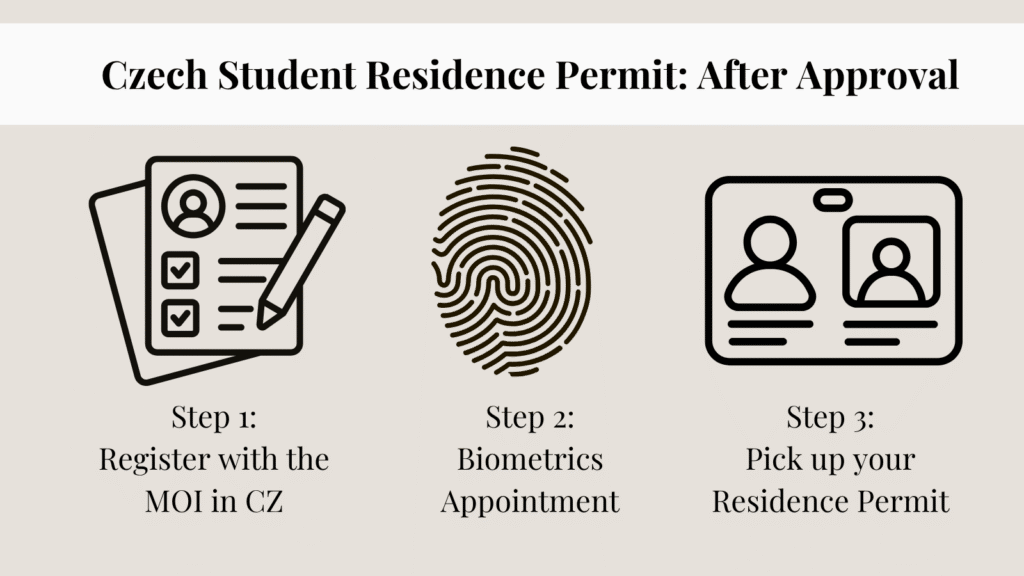
Once you land in the Czech Republic, your first order of business is registering your address with the Ministry of Interior — and you’ll need to do this within 3 working days of arrival.
This is a slightly different path from the long-stay visa route, where registration happens with the Foreign Police. I’ll be transparent here: I actually registered with the Foreign Police rather than the MOI, but I believe this was specific to my situation — I had a residence permit from another EU country at the time and hadn’t yet applied for my Czech permit. If you’re arriving with a freshly approved Czech residence permit that you applied for from outside the country, plan to register with the MOI. If you have any uncertainty about which applies to you, confirm with your program coordinator or consulate before you arrive.
For MOI registration you’ll need your travel document and the registration form — linked below. Note that this is a different form from the Foreign Police registration form, so make sure you’re filling out the right one.
When you register, the MOI will schedule your biometrics appointment. If you end up registering your address with the Foreign Police instead, you’ll need to call the client center to arrange your biometrics appointment separately. Either way, be prepared for the appointment to be a little ways out — availability can be limited. In my case it took two months to get an appointment. If you need to travel while you’re waiting, you can ask for what’s called a bridging visa — more on that below.
Bridging Visa
While you’re waiting on your biometrics appointment, you might find yourself in a situation where you need to leave the Czech Republic — whether for the holidays, a family visit, or anything else. This is where the bridging visa comes in, and it’s pretty common.
A bridging visa lets you legally travel and re-enter the Czech Republic while you’re waiting for your biometrics appointment. I needed one myself when I had to go home for Christmas while waiting on my biometrics appointment. It’s not a complicated process, but it is an extra step — so if you know you’ll need to travel before your permit card is in hand, plan ahead and don’t leave it until the last minute. You can call the client center and they will help schedule the appointment.
Biometrics Appointment
You’ll most likely have your biometrics appointment at the student office in Hládkov, Prague 6 — this office specifically handles student applications, and the staff speak English, which is a relief compared to some other MOI offices.
The appointment itself is pretty straightforward. You check in at the kiosk, grab your ticket, and wait for your number to be called. At the appointment they’ll take your fingerprints, get a digital signature, and take your residence permit photo. And yes — they take a brand new photo at the appointment rather than using the one submitted with your application. I still wonder why they needed that original photo, but here we are. Fair warning: the photo they take is not exactly flattering, so mentally prepare yourself.
They’ll also schedule your permit collection appointment on the spot — usually a few weeks out — and give you a confirmation paper with general information about your permit, including when it expires and whether you’re allowed to work.
Picking Up Your Residence Permit Card
Finally — the day has come! To collect your physical residence permit card, you’ll head back to the student office at Hládkov (in most cases). Same drill as before: check in at the kiosk and wait for your number to be called.
At the desk you’ll sign for your permit and they’ll walk you through some key information — when it expires, any conditions attached (like whether you’re permitted to work), and a few general rules. They’ll also ask you to confirm that all the details on the card are correct before you leave. Then that’s it — you’re done! After months of paperwork, apostilles, appointments, and waiting, you are officially holding your Czech residence permit.
A Quick Note on Your Appointments
Do everything in your power to make your scheduled appointments — both biometrics and permit collection. These are extremely difficult to reschedule, and the bar for what counts as an acceptable reason is higher than you’d expect.
I learned this firsthand when my permit collection appointment landed during my first week of classes. My logic was pretty reasonable, I thought — I’m here on a student residence permit, and classes are quite literally the reason I’m in the country. Surely that’s a valid reason to reschedule? Apparently not. When I called the client center, I was told that classes were not an acceptable reason to cancel, and that if I wanted to proceed with rescheduling I would need to send a handwritten letter of apology for missing my appointment and then wait to see if they’d grant me a new one. I ended up just skipping a few classes to make the appointment.
So — do your best to keep the date they give you. Obviously if you’re sick or have a genuine emergency, rescheduling may be unavoidable, but go in knowing it’s not a simple process.
Resources:
- Registration with the MOI Info
- MOI Registration Form
- Czech Student Residence Permit Info: See 7-10
- Bridging Visa Info
If Your Application Is Rejected

First things first — rejections are extremely rare, especially for student visas and residence permits. If you’ve put in the work across this series, the chances of finding yourself here are low. That said, if you do receive a rejection, I want to make sure you know your options.
When your application is rejected you’ll receive written notification outlining the decision. This document will include three parts: the statement (the legal grounds for the rejection), the grounds of the statement (explaining why it was rejected and what documents or evidence were considered), and your rights (explaining how to proceed if you want to challenge the decision).
If you applied for a long-stay visa:
You have two options. The first is to request a new assessment of the reasons for not granting the visa. You have 15 days from the date you were notified to submit this request in writing to the authority that issued the decision. In your request you’ll need to clearly explain who is submitting it and in what way the decision conflicts with legal regulations — note that you cannot use facts or documents that you failed to include in your original application. The authority will inform you of the outcome within 30 days.
Your second option is to appeal the decision. Appeals must also be submitted within 15 days and in writing to the office that issued the decision — or via the Data Box. If you submit via Czech Post on the last day of the period, it is still considered on time.
If you applied for a long-term residence permit:
You have 15 days from the date the notification was delivered to submit a written appeal to the MOI. Given the complexity of the appeals process at this level, it’s a good idea to consult an immigration lawyer if you are in this situation — they’ll be able to assess your specific situation and give you the best chance of a successful outcome.
For full details on both processes, I’ve linked the official resources below.
Resources:
- Czech Student Visa Rejection Resources: See 6
- Czech Student Residence Permit Rejection Resources: See 6
- Request a New Assessment of the Reasons for Not Granting the Visa Info
- Appeal Info
Final Thoughts

And that’s a wrap on the Czech Student Visa and Residence Permit Guide! We’ve covered everything from figuring out which application path applies to you all the way through to collecting your czech visa or permit card. This is exactly the kind of roadmap I wish I had when I was going through the process myself — so I hope it’s been able to take some of the stress out of it for you. And if you have any lingering questions, drop them in the comments or send me a message directly — I’m happy to help.
Now that you’ve dealt with the hard stuff, it’s time to start planning the more fun parts of student life in Prague. I’ve written a lot of Prague guides to help you hit the ground running — where to eat, how to get around the city, and a whole series on free things to do in Prague. Student-friendly guides, written by a former student who’s been there.