

Your Czech Student Visa Timeline: Processing Time & What to Expect
Welcome back to Part 2 of my deep dive series on navigating the Czech student visa and residence permit process. If you’re new here, hi, I’m Anne — a former Master’s student who spent a year studying in Prague and lived through the Czech visa system firsthand. I came out the other side with a ton of knowledge I wish I had going in, and I created this series in hopes to make it easier for others starting the process.
In this post we’re breaking down the Czech student visa processing time — how long the process actually takes, when to start, and what can cause delays that can potentially throw off your whole study abroad plan. And if you’re unsure where this step fits in your application journey, explore the other posts in this series to ensure you’re following the right path from start to finish.
How long does it take for a Czech visa to be approved? Quick Answer: according to the Czech Ministry of Interior (MOI), they have 60 days to process your application once it’s officially accepted. Student visa or residence permit — same window. Sounds pretty straightforward, right?
Here’s the thing though — there are some caveats to that “60 day” number that can disrupt your timeline if you’re not prepared for them. Have no fear though, I break everything down below for an easy breezy visa process.
Quick Recap — Which Path Are You On?

Before we get into timelines, let’s do a quick recap from the last post. If you’re studying in Czech Republic for a semester or shorter program — anything less than a year — you’ll most likely be applying for a student visa. However, if you’re there for a full degree program, think bachelor’s or master’s, lasting more than a year, a residence permit is your route. This can get confusing though, so if you haven’t read my first post and want to learn more about the difference, check it out here.
How Long Does Czech Visa Processing Actually Take?
Now for the part you actually came here for — how long does this whole thing take once you actually submit your application?
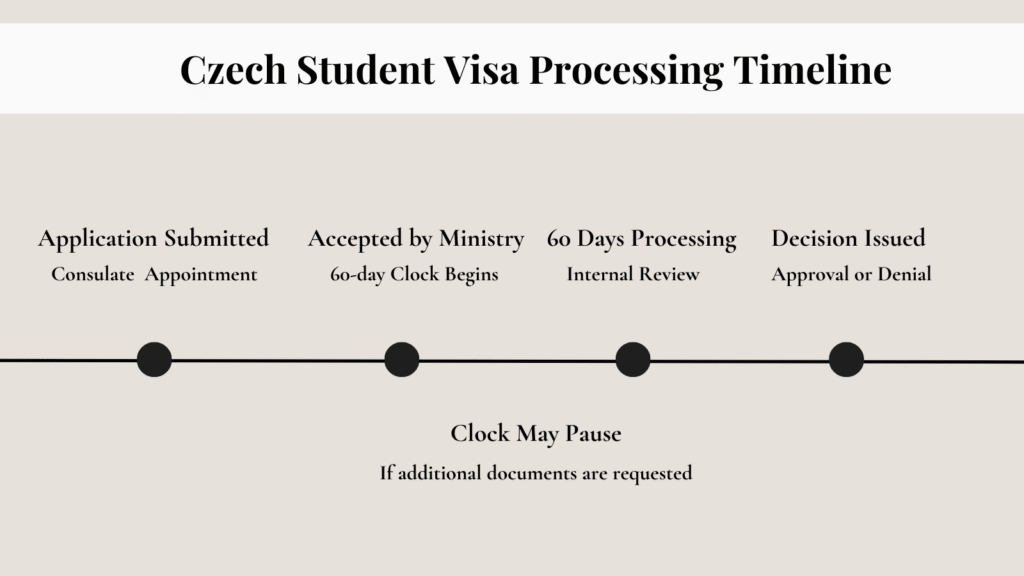
As I mentioned in the intro, the official word from the Czech government is that it takes 60 days for both the student visa and the residence permit. But here’s where it gets a little finicky. That 60-day clock doesn’t simply start the day you walk into your application appointment and hand over your documents. It starts the day the Ministry of Interior officially accepts it.
On top of that, if the Ministry decides they need additional documentation from you — say, more information from your landlord or clarification on your finances — they pause the clock entirely. Those 60 days freeze until you get them what they need. So depending on how smoothly your paperwork goes, that window can stretch quite a bit.
In my own experience, my residence permit was approved on day 59. Cutting it close! I’ve heard different things from others though — several of my friends had their permits approved well under the 60-day mark and were genuinely surprised mine took as long as it did. But I’ve also read accounts online from people whose applications went beyond the 60 days entirely.
The bottom line? Do everything in your power to make sure your documentation is complete and correct from the start — which I cover in detail in the next post. And please, don’t count on getting your application expedited. If there is one thing I’ve learned, it is that there is no rushing Czech bureaucracy.
When Should You Start on Your Visa Application?

So now you might be wondering — okay, but when should I actually start? Honestly, this is a trickier question to answer because there’s no hard and fast rule like there is for the 60-day processing window. It really does depend on your individual situation.
But here’s my advice: whatever timeline you have in your head right now, start sooner than that.
Even if you’re well acquainted with applying for European visas and residence permits, there still might be things in this process that take a little more figuring out than you expect — whether that’s sorting out your finances, finding accommodation, or getting certain documents apostilled. I’ll break all of that down in the next post, so don’t worry too much right now. What I want to stress here is that some of these things simply take time.
If you’re reading this post right now, you’re already in a great place to start familiarizing yourself with the requirements and getting organized. Start earlier than you think you need to. It’s always better to have the visa application checked off your list so you can move on to the more exciting parts of preparing for your time abroad.
What Can Cause Delays in the Czech Visa Process?
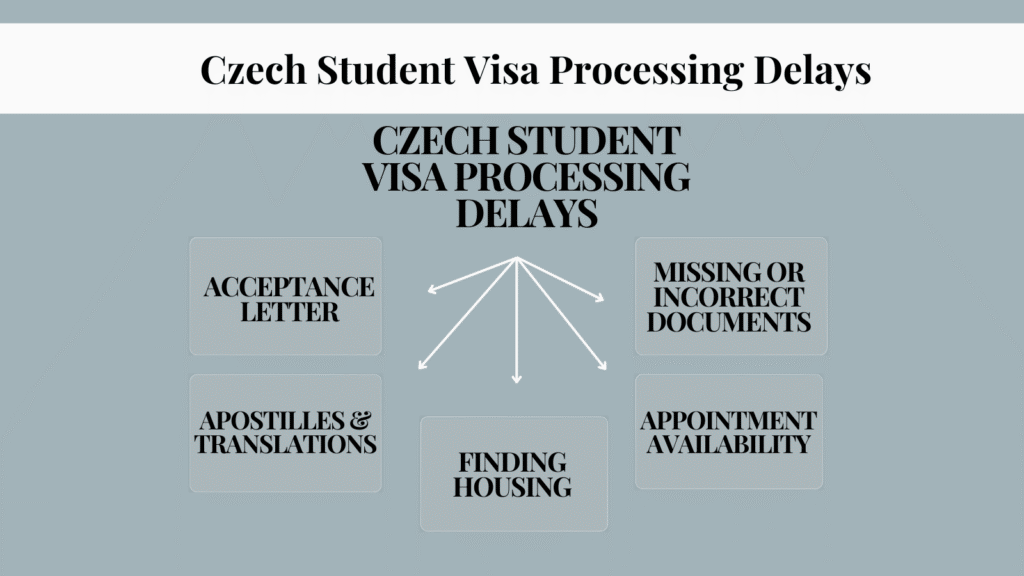
To summarize, here are the main things to watch out for to keep your application timeline on track.
- Waiting on your acceptance letter — completely out of your hands, but it controls when everything else can begin. In my experience, universities are pretty good about getting this to you well in time but be sure to stay on top of this.
- Missing or incorrect documents — this pauses the 60-day clock until you sort it out, so double check everything before you submit.
- Apostille and translation requirements — some documents need to be officially certified and translated into Czech, which takes time, especially from the US.
- Finding housing — particularly if you’re going for a private room over the dorm route
- Application appointment availability — slots can fill up, so book as soon as you can.
None of these are reasons to panic — they’re just reasons to plan ahead. And being aware of them already puts you ahead of most people going into this process.
Frequently Asked Questions
Can I check the status of my Czech Visa/Residence Permit online?
Yes! The Czech Ministry has an online portal where you can track your application status. All you need is your application reference number or visa application number (ŽOV). This information will be given to you when you submit your application, so be sure to keep track of it. I personally found that this portal wasn’t always the most informative — it’s fairly basic in terms of the updates it provides — but it does give you something to check in on. If you have specific questions or concerns, you can also reach out to the consulate directly.
What if my program start date is getting close and I’m still waiting?
This is a stressful situation and unfortunately the Czech system isn’t known for expediting applications, so don’t count on a ton of leeway there. Your best bet is to reach out to your university’s international student office — they’ve likely seen this situation before and may have advice or be able to help in some way.
Can my application be denied?
Yes, it can. The most common reason is incomplete or incorrect documentation, which is why getting your paperwork right from the start is so important. This is exactly what I cover in the next post, so stay tuned.
Do I have to apply for the Czech Visa from the US?
In most cases, yes — you’ll be submitting your application at a Czech consulate within the US based on where you permanently reside. There are some exceptions to this, but I cover all of that in depth in an upcoming post.

Final Thoughts
I know this post covered a lot, but I want to leave you with this — the Czech student visa and residence permit process is completely manageable. Yes, the timeline can feel uncertain and the bureaucracy can test your patience, but thousands of international students navigate this every year and come out the other side just fine. You’ve already taken one of the biggest steps by doing your research ahead of time, and that matters more than you might think.
If you have any questions after reading this, drop a comment below or send me a message — I’m happy to help where I can and share what I know from my experience.
Up next we’re getting into the nitty gritty of the actual document requirements — everything you need to gather, what can trip you up, and how to make sure your application is as airtight as possible before you submit.
Resources
While I always try to keep my blog posts updated with any new updates or requirements, please be sure to double check the below resources for more information on visa and residence permit specifics.