

Understanding the Difference Between a Czech Student Visa and a Residence Permit
Studying abroad is one of the most exciting opportunities you can have as a student — but before you get to the fun part, there’s some not-so-glamorous groundwork to tackle first. Navigating the Czech visa and residence permit system can feel overwhelming — even if you’ve already gone through the process of living abroad before. Between trying to decode government websites, requirements that differ based on your situation, and the very real pressure of getting it right before your program starts, it’s a lot to navigate on your own.
Having gone through this process myself as a Master’s student in Czech Republic, I know firsthand how stressful and full of red tape it can be. I’ve developed this guide to help other students navigate the Czech bureaucratic system with ease. It’s broken down into five digestible parts. Find exactly what you need based on where you are in the process — whether you’re just starting to research or waiting on an approval. This guide is designed for American students planning to study in Czech Republic, though much of it will be relevant if you’re from anywhere outside the EU.
This first part covers the foundation: the difference between a Czech student visa and a residence permit, and which one you actually need.
The quick answer: So what is the difference between a Czech student visa and a residence permit? On the surface these two terms might seem interchangeable — but they’re not. Here’s the short version: if you’re planning to study in the Czech Republic for just a semester, you’re most likely looking at a long-stay visa (Type D). If you’re planning to complete a full degree program abroad — think a bachelor’s or master’s — you’ll probably need a residence permit. Don’t get overwhelmed just yet. Buckle up, because I break everything down below.
First Things First: Does Your Program Count as “Study” in the Czech Republic?

Before diving deeper into visas and permits, let’s make sure you’re in the right place and that your program actually qualifies as “study” in the eyes of the Czech government — as not every academic situation is treated the same way.
If any of the below sound like you, this guide is for you.
- A university degree program (bachelor’s, master’s, PhD)
- A semester or year abroad as part of your home university’s program
- A language or prep course tied to and organized by an accredited Czech university
- A high school exchange program
These are the most common situations, but there are a few additional qualifying scenarios beyond this list — you can find the full breakdown in the resources section at the bottom of this post.
If your program doesn’t fall under any qualifying category — like a standalone language course at an unaccredited school — your process looks a little different and is outside the scope of this guide. In that case, reaching out directly to your program or the Czech embassy is your best next step.
What Is a Czech Student Visa?
Let’s say you’re heading to Prague for a semester abroad. Maybe your university has a partnership with Charles University or another Czech institution. You’ll be there for four to five months. In this case, what you’re looking for is a Czech student visa — or in fancy pants Czech bureaucratic terms, a long-stay visa (Type D).
Fun fact: The “D” in Type D stands for dlouhodobé — Czech for “long-term.”
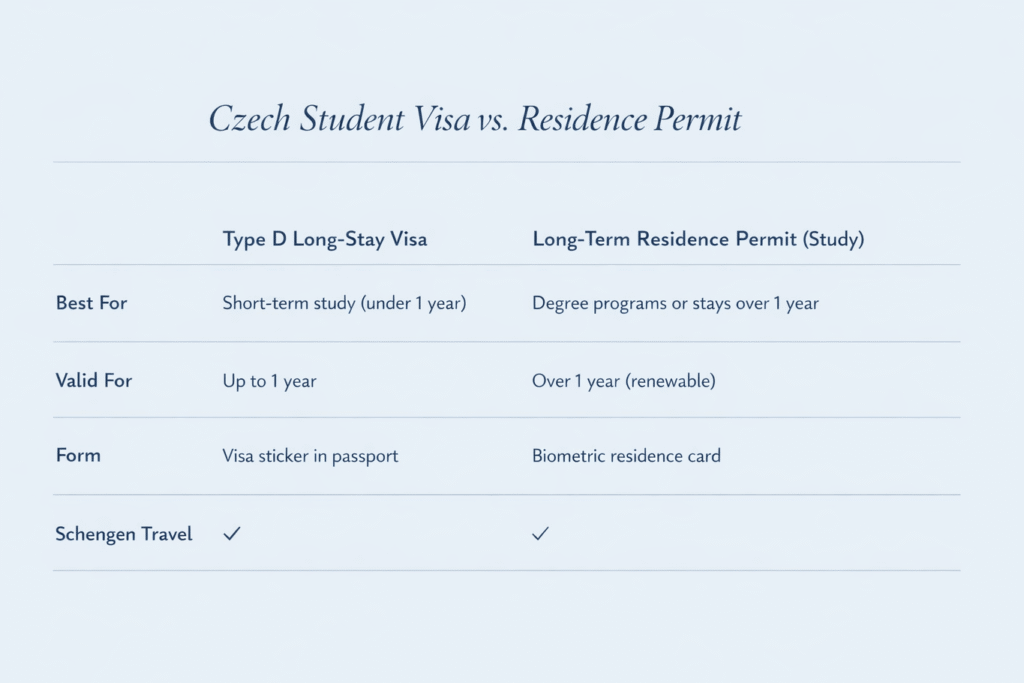
This visa is valid for up to one year. It’s issued as a physical stamp or sticker directly in your passport. Think of it as your official “yes, you’re allowed to be here and study” document. It also allows you to travel freely within the Schengen Area and re-enter Czech Republic worry free. So weekend trips to Vienna or Berlin are doable and encouraged.
What Is a Czech Residence Permit?
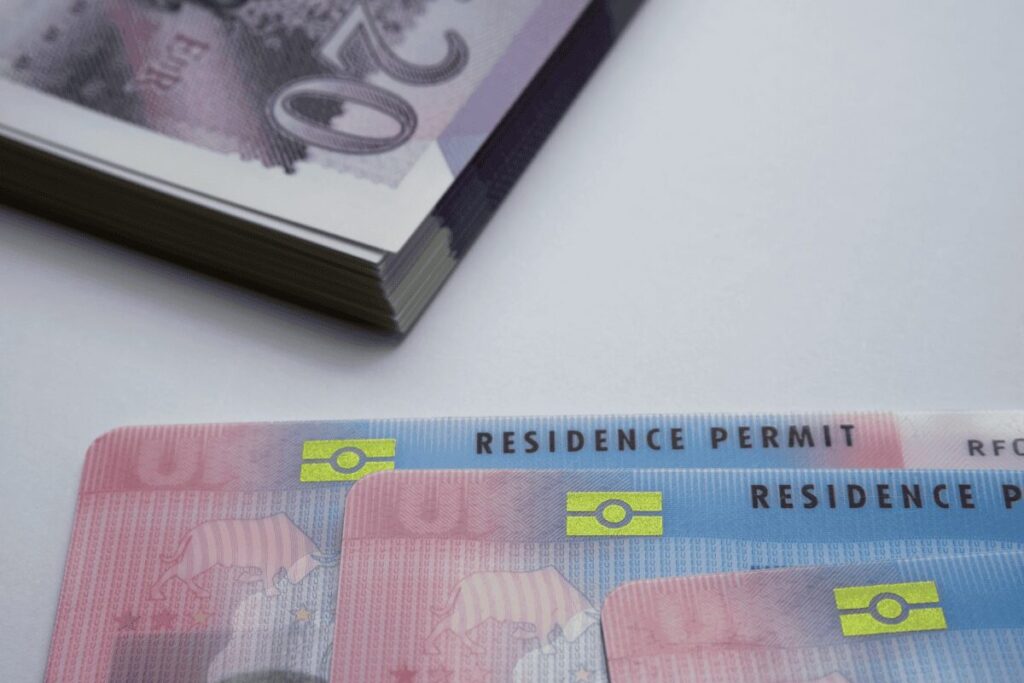
So now that you know what a student visa is, let’s tackle the residence permit for students. If you’re coming to Czech Republic to complete a full degree program — a bachelor’s, master’s, or PhD — you’ll be applying for a long-term residence permit for the purpose of study. The key difference from the Type D visa comes down to length of stay. A Type D visa covers you for up to one year. A residence permit is for longer than that.
Think of it this way: a Type D visa is your entry point. A residence permit is a deeper level of official recognition — you’re a longer-term resident, not just passing through for a semester.
One practical difference: a residence permit comes as a physical biometric card, not a passport stamp. As for perks — like the Type D visa, it allows you to travel freely within the Schengen Area. But unlike the Type D visa, the residence permit gives you free access to the Czech labor market. You can work here without needing a separate work permit.
Do You Need a Visa or Permit?
Now that you know the difference, let’s get to the part that actually matters — figuring out which one applies to you. And fair warning: this is one of the fuzzier parts of the Czech immigration system, even on the official government websites. So if you’re confused, you’re not alone.
General rule of thumb:
If you’re coming for a semester or short-term program (under one year) You’re looking at a Type D long-stay visa. This covers exchange students, semester abroad programs, and any study commitment under a year.
If you’re coming for longer than one year A long-term residence permit is the way to go. Unlike the Type D visa, a residence permit provides more permanent legal standing for extended study.
If you’re coming for exactly one academic year — here’s where it gets confusing Technically, both options are open to you. The official Czech government website even states that it is your decision whether you apply for a Type D visa or apply directly for a residence permit.
In my own experience, I came to Czech Republic for a double degree program — two semesters, one full year. Even though I technically could have applied for a Type D visa, I went for the residence permit. My reasoning: it gave me access to the labor market without a separate work permit, and it would have made renewing much easier had I decided to stay in Prague after graduating.
If you’re still unsure which route to take, that is completely normal — the official guidance is unclear on this. My advice is to reach out to someone in your specific program and confirm before investing time and energy preparing the wrong application.
Frequently Asked Questions
As an American, do I need a visa to visit Czech Republic? And what is Schengen entry?
As a US citizen you can enter Czech Republic visa-free for up to 90 days within any 180-day period. No visa, no paperwork — just your passport. This is what’s known as a Schengen entry. The Schengen Area is a group of 29 European countries operating under a shared border agreement. Once you enter one Schengen country, you can move freely between all of them. Czech Republic is part of this zone, so your 90 days applies across the entire Schengen Area — not just within Czech Republic. It’s only when you’re staying longer that a Type D visa or residence permit comes into play.
Can I study in Czech Republic on a Schengen entry?
Not usually — and this is one of the most common mistakes students make. A tourist or standard Schengen entry that you use to enter Europe for 90 days oftentimes does not give you the legal right to enroll in and attend a Czech university. You typically need either a Type D long-stay visa or a residence permit depending on your situation.
What if my program is under 90 days?
If your program is under 90 days you may be covered under a standard Schengen entry — no visa required. This was actually the case for me during my bachelor’s degree; I did a short study abroad summer program in Austria and didn’t need a visa at all because my stay was only 40 days. So if you’re not wanting to deal with the visa process at all, a shorter-term program can be a great option. That said, always confirm with your university or program coordinator before assuming this applies to you.
Final Thoughts & Next Steps

Navigating the Czech immigration system as a student can feel like a lot. But once you understand the foundation, the rest of the process becomes much more manageable. Before anything else: know what you’re applying for and why.
If you’re feeling a little lost after reading this, drop a comment below or send me a message. I’m happy to point you in the right direction based on my own experience.
Ready to keep going? The next post breaks down the Czech student visa timeline. We’re talking how early to start preparing, how long the process takes, and what can cause delays. Trust me, you don’t want to skip this one.
Resources
While I always try to keep my blog posts updated with any new updates or requirements, please be sure to double check the below resources for more information on visa and residence permit specifics.